UPDATE 2.3 IS OUT3D ELECTION MAPSTART A CAREER IN ANY YEAR FROM 1960HISTORICAL RACES: 1960–2024PRIMARY NIGHT, COUNTY BY COUNTY36 PLAYABLE CITIESCUSTOM POLITICAL PARTIESSTEAM EDITION $9.99, NO SUBSCRIPTIONOPTIONAL LOCAL AIUPDATE 2.3 IS OUT3D ELECTION MAPSTART A CAREER IN ANY YEAR FROM 1960HISTORICAL RACES: 1960–2024PRIMARY NIGHT, COUNTY BY COUNTY36 PLAYABLE CITIESCUSTOM POLITICAL PARTIESSTEAM EDITION $9.99, NO SUBSCRIPTIONOPTIONAL LOCAL AI
Player Guide
How to play
Start here for help with your first campaign. The sections below cover career setup, governing, Congress, foreign policy and saves.
For a presidential race, choose Full Campaign. To begin in office, choose Quick Play Presidency. Start a Career lets you create a politician and keep playing as they move between jobs.
Classic campaigns use minigames, and governing decisions include written choices. If you prefer to type a response, use Freeform mode or the "write my own answer" button.
Campaign goal
Win delegates in the primary, then aim for 270 electoral votes in the general election. Campaign actions use time and money. Polls update when you end the week.
Governing goal
Manage approval, legislation and crises through your term. Your record affects re-election and your final legacy score.
Career goal
Choose a party and platform, then run for office. Your résumé records election results, achievements and controversies for future campaigns.
Writing a response
Give a specific instruction. Say what you want done, which agency should do it and how it will be funded.
Each turn: check your polls or briefing, choose your actions, then advance time. Approval, money and relationships carry over to later turns.
Career Ladder
Setting up a career
Your career profile is stored separately from ordinary saves. It keeps your identity, platform, offices, election results and achievements, along with controversies that can affect future races.
Choose your character.
Your home state determines your local and statewide races. Party, platform and background affect voter support, fundraising and the attacks opponents use.
Pick a start year.
A new politician can start in any year from 1960. A past start is set in its own year, with that year's map, issues, politicians and real candidates, until you reach the White House.
Pick a starting office.
Lower offices let you build experience before a national campaign. You can start with a presidential run, but you will have less of a record to campaign on.
Set your platform.
The custom platform lets you place yourself on a compass and write issue positions in your own words. Those positions affect how the game describes and scores you.
Check your record.
Tax rises, controversial pardons, rivalries and failed campaigns can become attack lines in later races.
Name Recognition
Helps a later run start with more credibility.
National Profile
Makes presidential runs more plausible after state or federal office.
Home Approval
Affects re-election and later campaigns.
Scars
Permanent record items opponents can use.
Campaign Trail
Campaigning week by week
Campaign actions move money, momentum, ground game, media, and state polling.
Choose campaign actions during the week, then use End Week to advance. Your opponents act, events occur and polls update at that point.
Rallies and town halls
Best in reachable swing states. Deeply hostile states resist movement, and safe states cap gains. Your home state and vice president can add regional value.
Fundraising
Raises cash, especially with endorsements and ground organization, but costs momentum because you are off the trail.
Ground game
Canvassing and grassroots work build support that makes later campaign actions more effective.
Media and attacks
Speeches, press tours, research and ads can move support. Attacks and policy pivots can also backfire.
Primary versus general: watch delegates and rival support during the primary. In the general election, use state polls to find the races that could decide the Electoral College.
Election Night
Reading the results
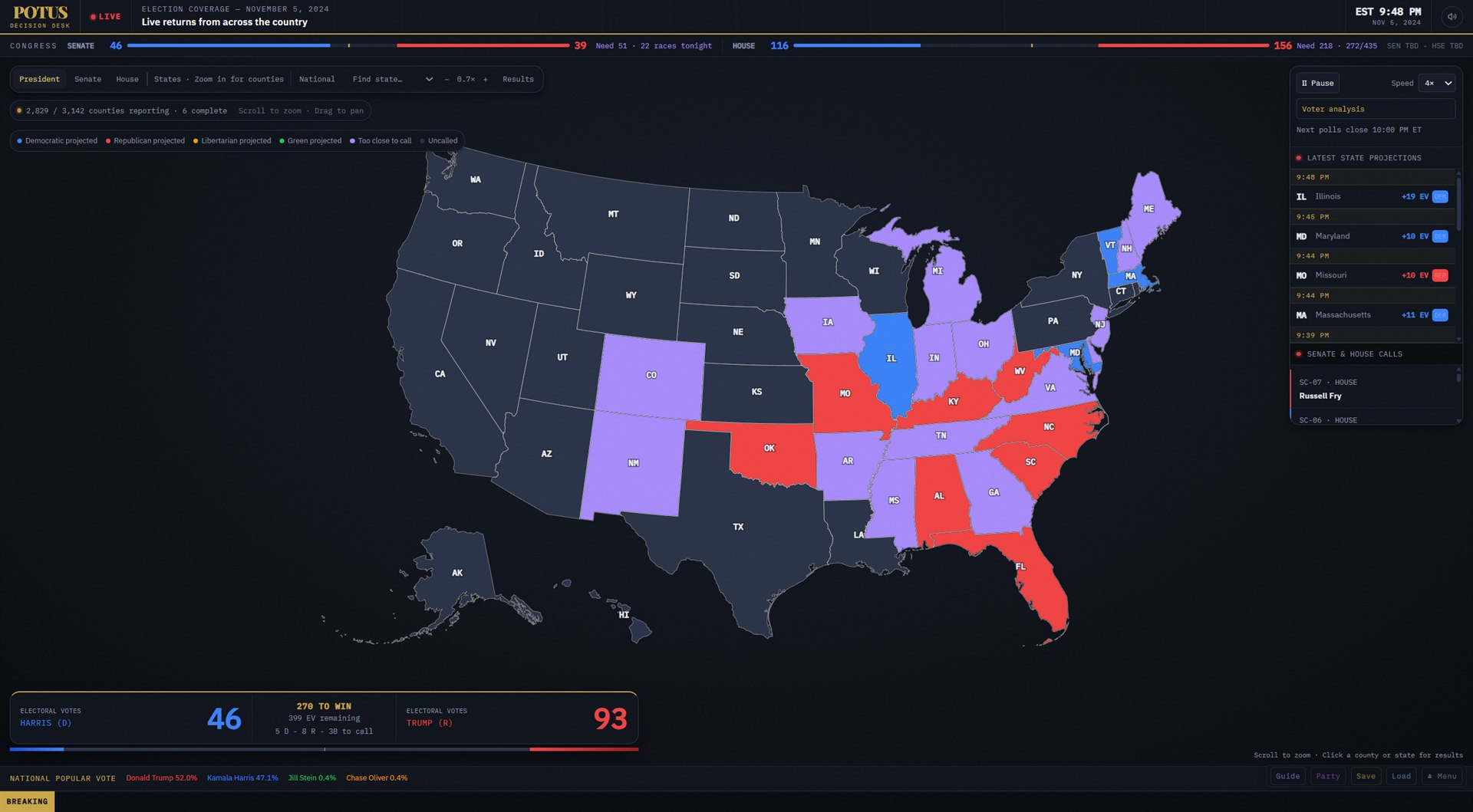
Election night runs as a live broadcast. The target is 270 electoral votes.
Your campaign decisions are finished when election night begins. Watch polls close and counties report in batches. State calls appear as the count progresses, alongside results for the House and Senate.
Watch the battlegrounds
Keep track of close states and their electoral votes. Large margins in safe states cannot make up for losing the states you need to reach 270.
Use the tabs
Switch between President, Senate, House and Counties. Click any county or district for its count, and set the speed, or pause, from the panel on the right.
Calls wait for the count
A state is called only when enough of the vote is in to support it. A close state can stay uncalled long after its polls close, so an early lead is not a win yet.
Review a defeat
After a loss, check where you spent money and campaign time, and whether your ground game was strong enough in close states.
The Presidency
Playing a presidential term
Read the daily briefing and choose your actions before advancing the day. Your term includes the First 100 Days, midterms, a re-election campaign and a final legacy grade.
Watch approval
Approval affects your political strength and re-election chances. Daily changes are capped, so recovering from a long decline takes time.
Maintain departments
Department performance affects how well policies work. Check agency condition before relying on it to carry out a major decision.
Write orders clearly
For free-text decisions, specify the agency, tool, funding, legal basis, target, timeline, and what compromise you are willing to accept.
Manage your staff
Appointees can act without asking first. You can reprimand, reassign or dismiss them.
Check the briefing.
Look for who has authority, who pays the cost, which institution can block you, and which public group will react.
Protect the midterms early.
Low approval can cost your party seats. Consider the coming midterms when planning legislation and spending political capital.
Keep up routine policy work.
Routine policy work improves departments and helps them carry out decisions when a crisis arrives.
Powers & Congress
Working with Congress and the courts
Executive actions, bills, vetoes, judges, treaties, and amendments each use different rules.
Bills
Draft a bill, find sponsors and check the whip count. Individual members vote according to their positions; amendments and party pressure can change support.
Vetoes
Signing, vetoing, or letting a bill become law are distinct choices. A veto can trigger a two-thirds override attempt in both chambers.
Executive orders
Useful when Congress stalls, but vulnerable to courts, bureaucracy, future reversal, and public backlash if they stretch authority too far.
Supreme Court
Check a nominee's views and Senate support. The Court's membership affects how it rules on challenges to laws and executive actions.
Treaties
Treaties need Senate ratification. Build relationships before you need 67 votes.
Amendments
Check support in Congress and state legislatures before proposing an amendment. Both stages must pass for it to take effect.
World Stage
Using the world map
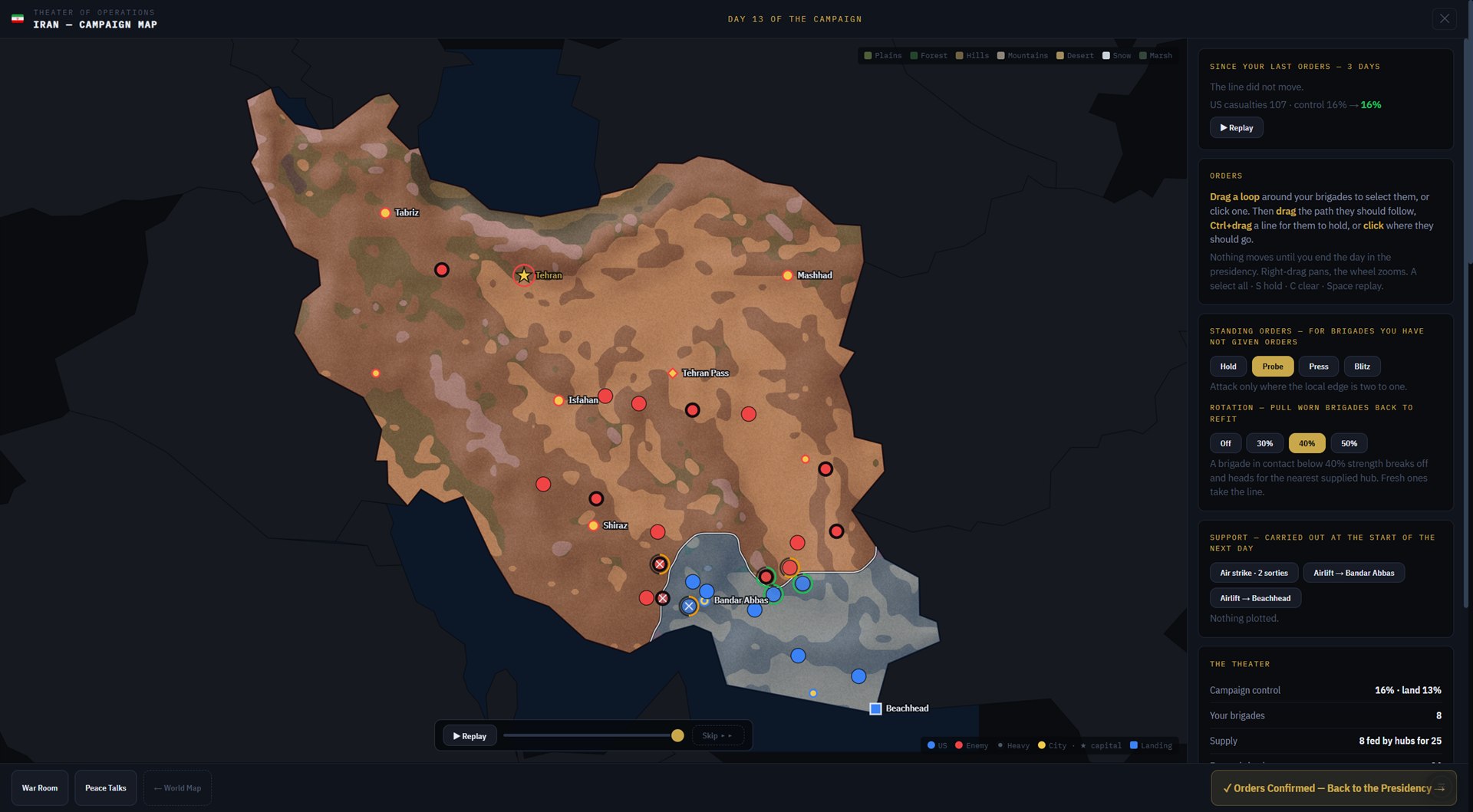
A war is fought brigade by brigade on the country's real terrain. Nothing moves until you end the day.
The world map tracks countries and blocs over time. Relations, alliances, wars, sanctions, military posture, covert actions, and nuclear risk can shift before and after any single crisis card.
Track relations
Summits, sanctions, treaties, aid and military actions change relations and affect later negotiations.
Check the cost of war
Military escalation can solve an immediate problem and create approval, budget, casualty, diplomatic, or congressional problems later.
Give the brigades orders
Drag a loop to select brigades, then drag the path they should take. Standing orders (Hold, Probe, Press, Blitz) cover the ones you leave alone. A war left on Hold becomes a quagmire.
Maintain supply
Reinforcements land at beachheads, ports and airbases you hold. Rotate worn brigades out before they break, and watch the replay after each day.
Watch nuclear escalation
Changes to nuclear posture and alerts can increase the risk of a strike. Read the warnings before escalating.
Consider exposure
It can avoid public confrontation, but discovery and blowback can become larger than the original problem.
Lower Offices
Serving in other offices
State Legislator
Represent a district, work on local bills and build relationships within your party.
Mayor
Immediate city problems, service quality, treasury limits, councils, unions, neighborhoods, and visible consequences within days.
Congress
You are one vote out of hundreds. Clout, committee assignments, party unity, leadership, floor time, and home approval matter. Win a gavel and you run the committee: hearings, markups, investigations and nominees.
Governor
Statewide approval, treasury, economy, vetoes, clemency, disasters, National Guard calls, a State Defense Force, legislative overrides, and national profile.
Cabinet Secretary
You run a department, but the President can end your career. Department performance and White House standing are the core tension.
Vice President
Take policy assignments, break Senate ties and prepare for possible succession. Your standing with the president also matters.
Modes & Saves
Choosing a mode and saving
Full Campaign
Best for learning elections. Start with candidate setup and play through primary, general, election night, and possibly the presidency.
Quick Play Presidency
Skip the campaign, choose your starting conditions and begin a presidential term.
Challenge Scenarios
Choose a scenario with a set starting situation and an objective to complete.
Historical Elections
Replay elections from 1960 through 2024 and try to bend real electoral maps away from history.
Quick Simulators
The Quick Election Simulator runs any matchup county by county. The Quick Midterm Simulator runs a whole midterm night from the President's approval and each party's strength.
Political Playground
Short toys built from the main systems: Policy Lab, Situation Room, Spin Room, Cabinet Draft, voter persona quiz, and Hall of Fame.
Save, Load, Resume
Six save slots, and the game auto-saves during governing. Resume Career returns to the relevant politician, office, campaign, or resume path.
Winning Tips
A few things that help
Do not over-invest in impossible states.
Hostile and safe states resist movement. Work the places that are close enough to move and valuable enough to matter.
Build capacity before the crisis.
Ground game helps campaign moves; department performance helps governing moves; relationships help Congress and diplomacy.
Use risky moves sparingly.
Policy pivots, attack blitzes, covert action, and escalation can work, but repeated use makes blowback more likely and more damaging.
Be specific in custom answers.
Say who should act, what they should do and how you will pay for it. Include a fallback if your first proposal needs support you do not have.
Check what went wrong.
Review your finances, campaign organisation, approval and relationships after a setback. Your career record may also explain an opponent's advantage.